

Rules and ethics
Part of When to check marketing agencies' UK compliance
Before you sign marketing agencies commercial contracts as a buyer
The contract terms English buyers should check before signing with a marketing agency, plus a scoring rubric and the law behind each key clause.
What to take away
- Most teams negotiate price first and leave termination, intellectual property and data processing to the week before signature.
- A statement of work that names deliverables, dates and acceptance criteria is what makes the contract workable.
- Consumer cancellation rights do not cover business-to-business agency contracts, so the exit route has to be written in.
- Personal data handled by an agency needs a processor agreement reflecting the retained UK GDPR, not a generic confidentiality clause.
- Whoever holds the ad accounts and the substantiation file has an advantage when the relationship ends, so settle both early.
Review order and criteria
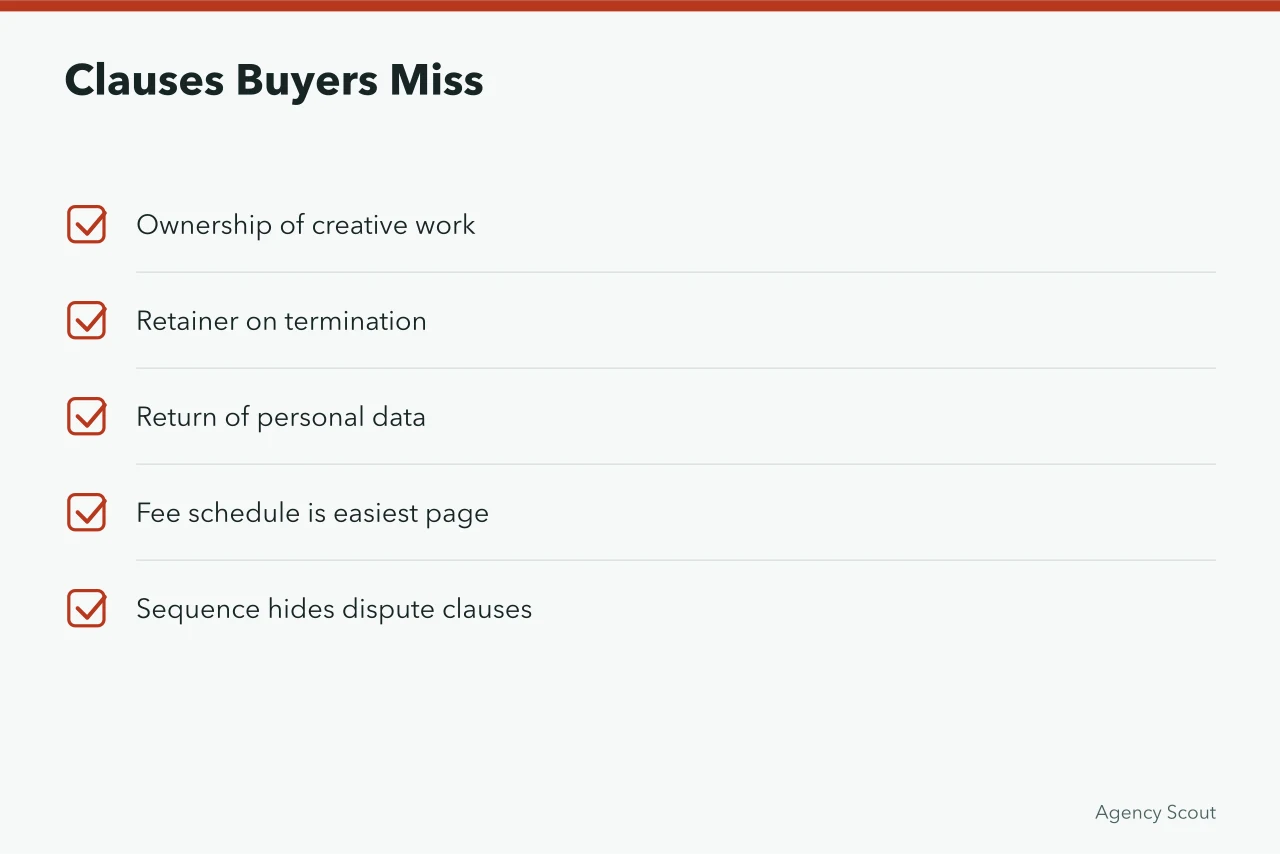
Buyers often start with the fee schedule because it is the easiest page to understand. That sequence hides the clauses that cause disputes later: ownership of creative work, the retainer on termination, and the return of personal data.
The clauses below assume English law. Scots law differs on procedure. The linked UK rules and compliance guide for 2027 gives wider statutory background.
Scope and statement of work
A master services agreement sets the framework; the statement of work sets the job.
Statement of Work Checklist
- Name deliverables and formats
- List channels and review rounds
- Set dates and late input rules
- Define acceptance criteria
- Count revision rounds inside fee
Name deliverables, formats, channels, review rounds and dates. Say what happens if your input is late. Agree acceptance and revision rounds inside the fee.
Fees, media and pass-through costs
Separate the agency fee from media spend and third-party costs. Ask whether media is bought as principal or as agent, because that decides who holds the platform contract and who carries credit risk.
Check the liability cap: 100% to 200% of fees paid in the previous 12 months is typical, with carve-outs for fraud, death or personal injury, and IP infringement.
Where the agency earns platform commission, the contract should say so. The CIM code of professional conduct expects members to be transparent about commercial interests.
Intellectual property and licensing
Ownership of creative work should be stated, not assumed. Under the Copyright, Designs and Patents Act 1988, copyright stays with the author unless assigned in writing.
An example clause is: The Agency assigns to the Client all copyright in the Deliverables on full payment and grants the Agency a non-exclusive licence to use the Deliverables in its portfolio.
Check the licence for pre-existing tools, stock assets and fonts.
Data protection and processing
An agency touching customer data is likely to be a processor acting on your instructions. The retained UK GDPR and the Data Protection Act 2018 require a written processing agreement covering purpose limitation, security, sub-processors and deletion.
An example processor clause is: The Agency shall process Personal Data only on the Client's documented instructions, apply appropriate technical and organisational measures, and delete or return Personal Data within 30 days of termination.
Where an agency uses tools hosted outside the UK, the agreement should name the transfer mechanism. Our data protection for agencies in England piece covers campaign work.
Termination and exit
Business contracts carry no cooling-off rights, so the exit route is whatever the contract says. A typical notice period is 30 days, though media commitments often need 60 to 90 days.
An example clause is: Either party may terminate on 30 days' written notice; the Client may terminate immediately for material breach not remedied within 14 days.
Ask what happens to work in progress, media booked beyond the end date, and any ad account held in the agency's name.
Claims, substantiation and the CAP Code
In the UK, the Advertising Standards Authority (ASA) enforces the CAP Code, which requires advertisers to hold evidence before publishing claims. Sanctions include published rulings, ad alerts and referral to Trading Standards. The warning letters link covers a different regime.
Put the evidence duty in the contract: who holds the substantiation file, how long it is kept, and who signs off comparative claims.
Scoring rubric
Score each heading from one to five, multiply by the weight, and treat the result as a comparison aid. The weights are illustrative and not legal advice.
| Heading | Weight | Five |
|---|---|---|
| Scope and statement of work | 20% | Deliverables, dates, acceptance |
| Fees and costs | 15% | Fee and commission disclosed |
| Intellectual property | 15% | Assignment on payment |
| Data protection | 15% | Processor terms |
| Termination | 15% | Notice and handover |
| Claims | 10% | Evidence owner named |
| Liability | 5% | Caps and carve-outs |
| Disputes | 5% | Law and escalation |
Common questions
Do consumer cancellation rights apply to agency contracts?
No. Consumer cooling-off rules do not generally cover business-to-business engagements, so the contract must provide any exit right.
Who owns the creative work an agency produces?
It depends on the assignment clause. Many contracts transfer rights only on full payment.
Is a processor agreement always needed?
Where the agency handles personal data for you, yes. UK GDPR requires written processor terms.