

Reviews
How to review and score marketing agencies before you shortlist
A method for reviewing marketing agencies: evidence hierarchy, weighted scoring, comparison, due diligence, credentials and compliance checks before shortlisting.
What to take away
- A marketing agencies review is a documented, source-checked assessment of a firm's results, credentials, compliance and client handling, rather than a collection of opinions.
- Testimonials carry little weight alone. Named campaign outcomes, published award entries and verifiable certifications carry most of it.
- Comparison works when every shortlisted firm is scored against the same weighted criteria before any pitch takes place.
- Due diligence should cover data protection, named staff credentials and any sector regulator that touches your business.
- A review informs a selection process. It does not replace one.
How marketing agencies reviews are put together
A useful review answers three questions. What does the agency claim? What can an independent source confirm? Does the fit suit your brief? Only the middle question produces evidence you can compare across firms. The other two are judgement calls for your notes, not for the score.
Claims vs Evidence vs Fit
Agency claims
- Comparable across firms
- No
- Source
- Agency sales copy
- Counts toward score
- No
- Owner
- Agency
Published evidence
- Comparable across firms
- Yes
- Source
- Independent body
- Counts toward score
- Yes
- Owner
- Reviewer
Your view of fit
- Comparable across firms
- No
- Source
- Your notes
- Counts toward score
- No
- Owner
- Reviewer
Most weak reviews fail at the first step. They restate the agency's own sales copy and dress it up as assessment. That is repetition with a number attached, and it gives a finance director nothing to sign off.
Separate three things from the start: claims the agency makes, evidence somebody else has published, and your own view of fit. Published evidence is the only category that is genuinely comparable between competing firms.
Give the review one owner. A named person working to a scoring sheet and a deadline produces a decision. A committee produces a shortlist nobody can defend.
Write the review so a colleague could repeat it. If the method only works inside your head, it is not a method.
The evidence hierarchy
Rank everything you find. At the top sit outcomes published by a body with no commercial interest in the agency winning your brief. Award entries qualify because judges see the underlying results data, not the highlight reel.
The Institute of Practitioners in Advertising publishes its 2018 Effectiveness Awards winners with the campaign results behind each entry. Those write-ups work as citable case studies when you score a shortlist.
Below that sit client-approved case studies with named brands and dated figures. Below those sit anonymised case studies that describe a sector but never a client. At the bottom sit testimonials with no numbers, no dates and no named author.
A review that weights all four tiers equally is not a review. It is a survey of how well each agency writes about itself.
Map the tiers to numbers so the sheet stays consistent. Independent published outcome, five. Named client case study with dated figures, four. Named client case study without figures, three. Anonymised case study, two. Testimonial, one. Record the reasoning in the notes.
Ask for two case studies from the past 24 months in your sector, plus a client contact who will take a reference call. An agency that cannot produce both is telling you something about how it records its own work.
Smaller firms often have no award entries to cite. Ask instead for a client willing to share figures directly, and record that as tier two evidence with the client's name attached.
Scoring and weighting
Set your criteria before you read anything. A workable default weights evidence of results at 30 per cent, sector fit at 20, team credentials at 20, compliance at 15 and commercial terms at 15. Adjust to your situation, then apply the same sheet to every firm.
Weighting is where buyers reveal what they actually value. A business spending, for example, £400 a month on media has little exposure if a compliance process is thin. One spending £40,000 a month has a great deal. Same criteria, different weights.
Score each criterion out of five and record the source beside the score. If you cannot name the source, the score is zero. That rule removes most of the bias that creeps into agency comparisons, because it forces you to separate a claim from a fact.
Record who contributed to each score too. When two reviewers disagree by more than one point, discuss that criterion alone, then re-score. Whole-table debates rarely converge.
Ties happen often, particularly between firms of similar size. Break them by asking each finalist for a written plan covering the first 90 days, then judge which plan names real people, dates and deliverables.
Weights should move with deal size. For a pilot worth, for example, £3,000, speed and commercial terms matter more than a thick credentials pack. For a three-year retainer, compliance and team stability deserve the extra weight.
The marketing agencies review methodology in England guide sets out how to build the scoring sheet and document it, which matters if procurement or a board has to approve the decision.
Comparison methods that survive scrutiny
Comparison is a process, not a spreadsheet you fill in once. The aim is to cut a long list down to two or three firms you can defend, then test those firms against risks that only appear under closer inspection.
Comparison funnel stages
- Research8 to 12 firms
- Scoring4 to 6 firms
- Reference calls2 to 3 firms
- Set decision date before starting
Set a decision date before you start. Without one, comparisons stretch until everyone is exhausted, and the incumbent survives by default.
Shortlisting without a beauty parade
Do not let the agencies set the agenda. Send the same brief to every firm, ask for the same evidence in the same format, and set the same deadline for all of them. Differences in response quality then tell you something real.
Ask each firm for a written brief-back: two pages on how it reads your problem, what it would do first and what it would measure. This is the most useful comparison document you will receive, because nothing can hide behind a slide deck.
Score the response, not just the credentials. Did the agency ask a clarifying question? Did the plan address your actual constraint, or a more comfortable one? Did the timeline include the research weeks that make delivery possible?
Watch for the pitch team and the delivery team being different people. Ask who will run the account day to day, and whether those named individuals will attend the kick-off. Vague answers deserve a lower score, not the benefit of the doubt.
Reference calls deserve their own questions. Ask what the agency got wrong, how quickly it corrected course, and whether reporting arrived on time without chasing. Buyers are usually franker about process than about results.
Keep every response in one folder. When the decision is questioned later, the brief-backs show what each firm promised before it won the work.
A written checklist keeps this stage honest. The marketing agencies selection checklist in England covers the documents to request before you score anything, including references, insurance and process notes.
Credentials, compliance and client-side risk
Credentials are a filter, not a ranking. The Chartered Institute of Marketing awards Chartered Marketer status to individuals who meet its assessed standard. That tells you about a named person, not about the agency as a whole. Check the individual, not the logo on the pitch deck.
Platform certifications follow the same logic. LinkedIn publishes details of its LinkedIn Ads certifications, useful for checking that the people running your paid social hold current platform knowledge. Ask for profile links rather than a badge count.
Staff turnover is the risk credentials do not capture. Ask how many of the people named in the pitch are still on comparable accounts twelve months later. The answer predicts more than any certification list.
Compliance is where reviews often stop too early. If the agency will run email, SMS or paid social for you, its processes need to match the Information Commissioner's Office direct marketing checklist. That covers consent, suppression and the records a buyer should be able to audit.
Ask for the data processing agreement before the final round, not after it. If the agency cannot describe where client data sits and who can access it, the compliance score should reflect that gap.
Sector adds another layer. If you are a charity, or you work with charity clients, the Charity Commission's register and regulatory data is where governance history sits. An agency claiming charity expertise should be comfortable with that scrutiny.
In regulated sectors, final sign-off usually belongs to your compliance team rather than the agency. Agree early who approves copy and who keeps the audit trail.
Check insurance and contract terms before the final round. Two agencies that look equal on score often differ sharply on notice periods and ownership of creative assets. That difference is cheaper to find now.
What the decision table tells you
The table maps common buying situations to the comparison method that fits, and to the approach that tends to waste time or money. Use it before you build a shortlist, not after.
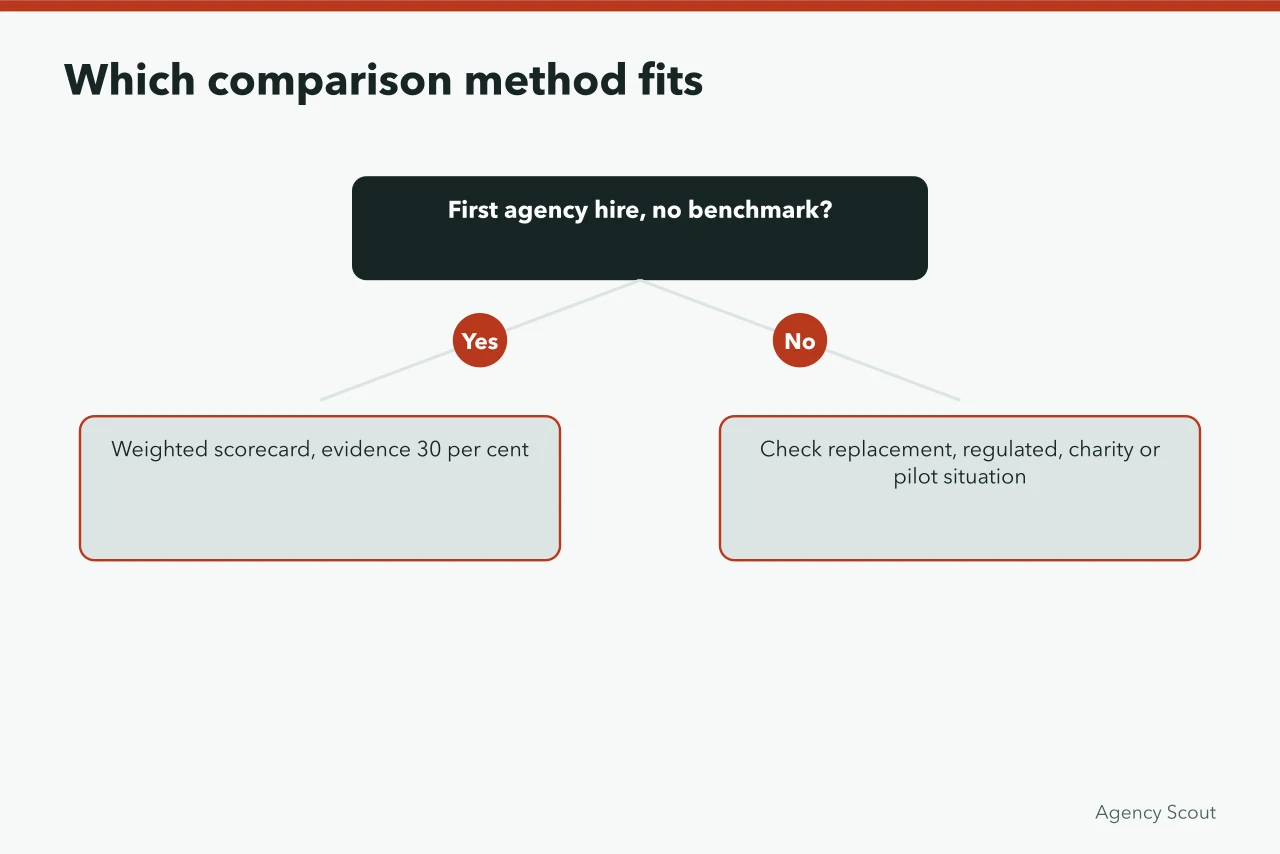
Choose
- First agency hire, no internal benchmark
- Weighted scorecard with published evidence at 30 per cent
- Replacing an agency that underperformed
- Review of measurement and reporting terms first
- Regulated sector such as finance or health
- Compliance-led review with named approvers
- Charity or non-profit brief
- Due diligence against Charity Commission records
- In-house team needs extra capacity
- Credential check on the named delivery staff
- Testing a new channel
- Small paid pilot with a written exit test
Avoid
- First agency hire, no internal benchmark
- Long pitch processes with no scoring sheet
- Replacing an agency that underperformed
- Re-running the same brief with the same criteria
- Regulated sector such as finance or health
- Agencies that cannot name a compliance lead
- Charity or non-profit brief
- Agencies with no trustee or governance experience
- In-house team needs extra capacity
- Agency-level certification claims with no names
- Testing a new channel
- Annual retainers signed before any pilot
If you want to see the criteria applied to real agency types before you shortlist, the marketing agencies best providers in England round-up walks through the categories.
Score first, discuss second. If the panel debates before the sheets are in, the loudest voice sets the criteria and the method collapses.
The table is deliberately blunt. Its job is to stop you applying a first-hire method to a replacement brief, or charity-grade due diligence to a fast pilot on one channel.
Two patterns stand out. Most failed agency relationships are chosen on presentation quality rather than evidence. The reviews that predict trouble check named people and compliance processes, not creative work.
Reading agency reviews you did not commission
Third-party reviews are useful for pattern spotting. Look for repeated comments across independent sources about the same behaviour, such as slow reporting or frequent staff changes. One angry review is noise. The same complaint in several places over two years is a signal.
Check the date on everything. A review of a digital marketing company from four years ago describes a firm that may no longer exist in any meaningful sense, particularly after a merger or a change of leadership.
Be sceptical of scores that cluster near the top with no detail behind them. A useful review names the work, the period and the outcome. Ask whether the platform accepts paid placement and whether negative reviews survive publication.
Volume matters less than consistency. Twenty reviews collected from one buyer's network are one opinion repeated twenty times.
Platforms differ in what they capture. Structured ratings are easy to track over time, while free text is better for spotting patterns. Use both, and note where each comment came from.
The marketing agencies agency reviews in England article explains how to read those patterns and combine them with your own scoring, so no single comment carries the decision.
Turning a review into a decision
A review should end with a recommendation and a reason. Write both down. A line naming published outcome data and the named account lead's certification is a decision. A line saying the agency felt right is not.
Set a review date. Agency performance drifts, and the firm you scored in September may have lost two senior people by the following spring. Re-scoring against the same criteria keeps the comparison honest.
Budget honesty helps too. Give every firm the same range and score how each one handles the constraint. An agency that ignores the number has told you how it will treat it later.
Put the recommendation, the reason and the re-score date in one document that the account team also receives. Agencies that know the criteria they will be judged on tend to manage to them.
Build measurement into the contract from day one. The marketing agencies measurement and reporting guide 2027 sets out reporting cadence and metrics that make a later re-score possible rather than anecdotal.
Agree the exit terms before you sign: notice period, ownership of creative and data, and how the account transfers if you leave. These clauses rarely get renegotiated once a relationship has gone wrong.
Keep the workings. If the choice is challenged six months later, a scorecard with named sources is evidence, and it takes minutes to produce.
Common questions
How many marketing agencies should I compare?
Four to six is workable. Fewer than three gives you nothing to compare, and more than eight usually means the scoring becomes shallow. Narrow to two or three before you check credentials in detail.
Are online review scores reliable for choosing an agency?
Treat them as one input rather than the decision. They are useful for spotting repeated behaviour over time. They rarely contain the outcome data or compliance detail you need, so pair them with your own scorecard and document checks.
What credentials should an agency be able to prove?
At minimum, named individuals with current platform certifications and, where relevant, professional status such as Chartered Marketer. For regulated work, ask who owns compliance and request the process documents. Vague answers are a warning sign.
How often should I re-run an agency comparison?
Annually for active relationships, or sooner if the account team changes or performance drifts. Re-scoring with the same criteria takes far less time than the original selection and shows whether the agency has kept pace.
In this guide
- What a marketing agencies review methodology should cover before you shortlistWhat a marketing agencies review methodology should cover, what sits outside scope, and how to separate vendor claims from independent evidence before shortlisting.
- How to test marketing agencies' claims before you shortlistHow to test the claims marketing agencies make before shortlisting: inclusion criteria, evidence checks, public records and a decision table for buyers.
- How to compare marketing agency proposals without sales fogA marketing agency comparison method: set a brief, ask consistent questions, check evidence and security, then score proposals on total cost.
- Why marketing agencies agency reviews need independent evidenceHow to read marketing agencies agency reviews without being misled: what buyers can verify, what was not assessed, and the checks that separate proof from claims.
- Marketing agencies selection checklist before signingA marketing agencies selection checklist for the signing stage: references, fee lines, claims rules, data transfers, exit terms and a day-90 review.